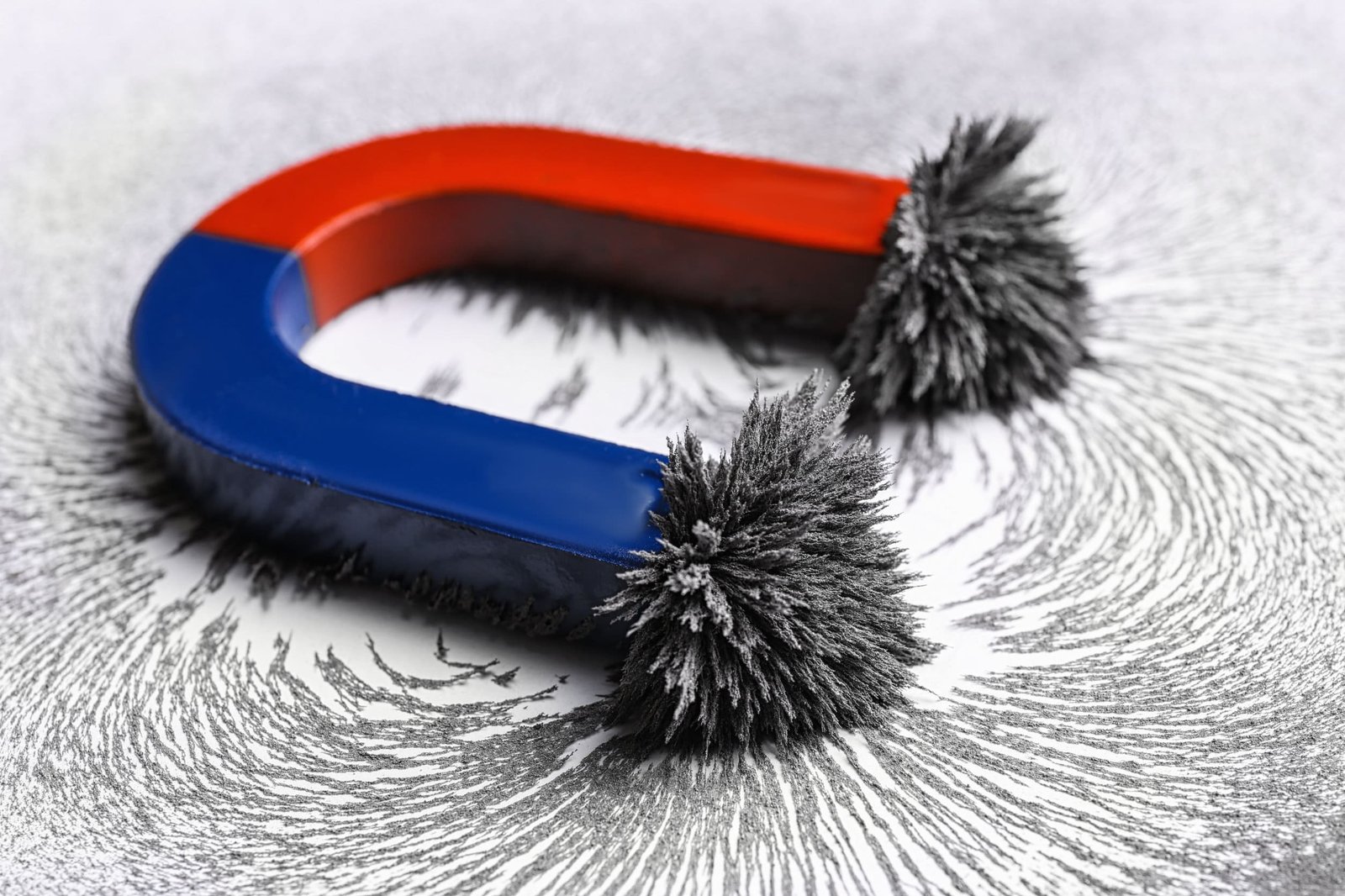
Why is iron attracted to a magnet but copper is not? Why does a heated magnet lose its power? This chapter takes you from the tiny magnetic moment of a single electron to the five great families of magnetic materials — with the diagrams and values examiners ask for again and again.
🧲 5 Magnetic Types🌡️ Curie–Weiss Law🔁 Hysteresis Loop📊 Verified Values
🧭
Origin of Magnetism
Where does magnetism come from? Every electron is a tiny magnet, and its magnetic moment comes from two motions:
Spin motion — the electron spinning on its own axis (this contributes the most in most solids).
Orbital motion — the electron revolving around the nucleus (in many solids this contribution is "quenched", i.e. cancelled by the crystal field, so spin dominates).
The magnetic moment of an atom is the vector sum of the moments of all its electrons. Two electrons with opposite spins (a paired pair) cancel each other's moment — that is why substances with all electrons paired are only weakly magnetic, while substances with unpaired electrons can be strongly magnetic.
Magnetic susceptibility: χ = M / H · it measures how strongly a material gets magnetised (M) in an applied field (H). Its sign and size tell us which type of magnetism is present.
Golden rule for this chapter:paired electrons → weak magnetism; unpaired electrons → the possibility of strong magnetism. Almost every exam question here reduces to counting unpaired electrons and seeing how their spins line up.
📊
The Five Types of Magnetic Materials
Learn this table as one block — it is the single most-asked question of the chapter ("Distinguish between dia-, para-, ferro-, antiferro- and ferrimagnetism").
Spin Alignments in Magnetic Materials
From paired spins (diamagnetic) to parallel (ferromagnetic), antiparallel (antiferromagnetic) and unequal antiparallel (ferrimagnetic).
Type
Spin alignment
Response to magnet
Susceptibility χ
Temperature effect
Examples
Diamagnetism
All electrons paired; no permanent moment
Weakly repelled
Small, negative
Independent of temperature
NaCl, H2O, Cu
Paramagnetism
Unpaired electrons; moments randomly oriented
Weakly attracted
Small, positive
χ falls as T rises — Curie law χ = C/T
O2, Cu2+ and Fe3+ salts
Ferromagnetism
Unpaired spins aligned parallel in domains
Strongly attracted; stays magnetised
Large, positive
Spontaneous magnetism only below Curie temperature Tc
Fe (Tc = 1043 K), Co (1388 K), Ni (627 K)
Antiferromagnetism
Equal numbers of spins antiparallel — cancel out
Very weak response
Small, positive
Ordered only below Néel temperature TN
MnO (TN = 122 K), NiO
Ferrimagnetism
Unequal numbers of spins antiparallel — net moment remains
Strongly attracted
Large, positive
Net moment falls with temperature, lost above Tc
Fe3O4 (magnetite), ferrites
🔍 Diamagnetism is universal
Every substance is diamagnetic at the atomic level, but the effect is so weak that it is hidden whenever unpaired electrons are present. It is seen clearly only when all electrons are paired.
⚖️ Antiferro vs ferrimagnetism
Both have antiparallel spins. In antiferro the two sets are equal → net zero. In ferri they are unequal → a net magnetic moment survives. One word — "unequal" — is the whole difference.
Memory trick:DIAmagnetism Denies the magnet (repelled) · PARAmagnetism is partially attracted · FERROmagnetism is fully attracted. And remember the Curie temperatures as a ladder: Ni 627 K < Fe 1043 K < Co 1388 K — "Ni-Fe-Co rising".
🌡️
Effect of Temperature: Curie and Curie–Weiss Laws
Heat shakes the aligned spins out of order. That is why every ordered magnetic state has a critical temperature above which it collapses into simple paramagnetism:
Curie temperature (Tc): above this, a ferromagnet (or ferrimagnet) loses its spontaneous magnetisation and becomes paramagnetic. Fe: 1043 K, Co: 1388 K, Ni: 627 K.
Néel temperature (TN): above this, an antiferromagnet loses its antiparallel order and becomes paramagnetic. MnO: 122 K.
Curie law (simple paramagnets): χ = C / T Curie–Weiss law (above Tc): χ = C / (T − θ) · θ is the Weiss constant (≈ Tc for ferromagnets). C = Curie constant, which depends on the number of unpaired electrons.
In words: for a paramagnet, susceptibility falls as 1/T because thermal motion fights the alignment. For a ferromagnet heated above Tc, the same idea holds but shifted by θ, which measures how strongly neighbouring spins wanted to stay aligned.
Exam tip: Examiners love the one-line distinction: "What is the difference between Curie temperature and Néel temperature?" Answer: Tc is where ferromagnetic order is lost; TN is where antiferromagnetic order is lost. Both turn into paramagnets above it. Write the MnO and Fe values alongside for full marks.
🔁
Cooperative Magnetism, Domains & Hysteresis
Cooperative magnetism means the atomic magnetic moments do not act alone — neighbouring spins cooperate and line up together over large regions. This cooperation is what makes ferromagnetism, antiferromagnetism and ferrimagnetism possible (and why they vanish above Tc/TN, where heat wins).
Magnetic domains. In an unmagnetised piece of iron, the parallel-aligned spins are grouped into tiny regions called domains (Weiss domains). Inside each domain all spins point one way, but different domains point in different directions — so the total magnetism cancels to zero. Neighbouring domains are separated by thin domain walls (Bloch walls). When an external field is applied, favourably oriented domains grow at the expense of others and their moments rotate toward the field — the iron becomes magnetised.
Hysteresis loop. If we magnetise iron to saturation and then remove the field, it does not fully demagnetise — it remembers. Plotting magnetisation against the applied field (and back) traces a loop:
Retentivity (remanence): the magnetism retained when the external field is reduced to zero.
Coercivity: the reverse field needed to wipe the magnetism back to zero.
The area of the loop = energy lost as heat in one cycle of magnetisation.
B–H Hysteresis Loop
Saturation Bs, retentivity Br and coercivity Hc — the loop area is the energy lost as heat in each magnetisation cycle.
Property
Soft magnetic materials
Hard magnetic materials
Hysteresis loop
Narrow loop, small area
Broad loop, large area
Coercivity
Low — easy to magnetise and demagnetise
High — keeps its magnetism
Energy loss per cycle
Small
Large
Used for
Transformer cores, electromagnets
Permanent magnets
Why this matters: a transformer core is magnetised and demagnetised 50 times every second — a broad loop would waste huge energy as heat. That is why soft iron (narrow loop) is used there, while hard steel (broad loop) is used for permanent magnets.
✎ PYQ Zone — Chapter 7
Every previous-year question from this chapter's topics, with year, paper, marks and a full exam-ready answer. Tap a question to open its detailed solution.
2019B.Sc. CC-112 marks🔁 2023
Q1(a) — “Exemplify the terms: magnetically dilute and magnetically concentrated substances.” ⭐⭐⭐⭐
Repeated: 2023 · B.Sc. CC-11 · Q3(d)(i) (2+2 marks): “What is magnetically concentrated compound and magnetically dilute compound? Explain with example.”
📖 Detailed answer ▼
Magnetically dilute substance: the paramagnetic centres (ions with unpaired electrons) are far apart, separated by diamagnetic ligands or a diamagnetic host lattice, so there is no significant magnetic interaction between neighbouring centres. Each centre behaves like an isolated magnet, and the susceptibility follows the simple Curie law, χ = C/T. Example: [Mn(H2O)6]SO4, or a trace of Cu2+ doped into diamagnetic ZnSO4.
Magnetically concentrated substance: the magnetic centres sit close together (as in metal oxides or the metals themselves), so neighbouring spins interact through exchange coupling. The susceptibility follows the Curie–Weiss law, χ = C/(T − θ), and below a critical temperature the solid orders ferro- or antiferromagnetically. Examples: Fe, Co, Ni metals; MnO, Fe3O4.
One line: dilute = isolated spins, Curie law; concentrated = interacting spins, Curie–Weiss law with magnetic ordering.
2023B.Sc. CC-112 marks🔁 3 years
Q3(d)(iii) — “What is super exchange phenomenon—state with example.” ⭐⭐⭐⭐⭐
Repeated: 2022 · B.Sc. CC-11 · Q2(b)(ii) (2 marks): “Define magnetic super exchange phenomenon.”; 2019 · B.Sc. CC-11 · Q3(c)(iii) (2 marks): “Cite an example of super-exchanged pathway with respect to a coordination molecule. What is the net effect?”
📖 Detailed answer ▼
Superexchange: in ionic solids (oxides, fluorides) the magnetic metal ions are too far apart for direct overlap of their d-orbitals, yet they still couple magnetically. The coupling happens indirectly through the filled p-orbitals of the bridging diamagnetic ion (usually O2−) sitting between them — the bridge “carries” the exchange by virtual electron transfer.
Example — MnO (rock-salt structure): Mn2+–O2−–Mn2+ links are linear (180°). The O 2p orbital overlaps a d-orbital on each Mn2+. By the Pauli principle the electron transferred virtually from O2− to one Mn2+ must be antiparallel to that ion's d-electrons, forcing the second Mn2+ to align antiparallel to the first. Result: antiferromagnetic coupling below the Néel temperature (116 K for MnO). NiO behaves the same way.
Goodenough–Kanamori rule of thumb: 180° M–O–M superexchange is usually antiferromagnetic; 90° superexchange is usually ferromagnetic.
2019 asked a coordination-molecule example: in copper(II) acetate monohydrate, [Cu2(OAc)4(H2O)2], the two Cu2+ ions couple antiferromagnetically through the acetate bridges — the net effect is a subnormal magnetic moment (~1.4 BM per Cu instead of the spin-only 1.73 BM).
2022 also asked double exchange (Q1(d) — see below): in mixed-valence systems (e.g. Mn3+–O–Mn4+ in manganites like La1−xSrxMnO3) an electron hops from Mn3+ to Mn4+ via oxygen without changing its spin — this real hopping favours parallel (ferromagnetic) alignment and gives metallic conduction. Double exchange = electron hopping (ferromagnetic); superexchange = virtual exchange through the bridge (usually antiferromagnetic).
2022B.Sc. CC-113 marks
Q3(c)(i) — “Define ferromagnetism and anti-ferromagnetism correlating with the spin exchange coupling constant (J).” ⭐⭐⭐⭐
Related: 2023 · B.Sc. CC-11 · Q3(d)(iv) (2 marks): “Give elementary idea on antiferromagnetism with example.”
📖 Detailed answer ▼
The coupling between two neighbouring spins is described by the Heisenberg exchange Hamiltonian:
H = −2J · S1·S2
The sign of J — the spin exchange coupling constant — decides the magnetic order:
J > 0 → ferromagnetism: parallel alignment of neighbouring spins is lower in energy, so the solid develops a spontaneous magnetisation below the Curie temperature TC. The susceptibility is very large and follows the Curie–Weiss law with a positive Weiss constant θ. Examples: Fe, Co, Ni (Fe: TC = 1043 K).
J < 0 → antiferromagnetism: antiparallel alignment is lower in energy; neighbouring spins cancel, so the net magnetisation is zero below the Néel temperature TN. The susceptibility passes through a maximum at TN and follows the Curie–Weiss law with a negative θ. Examples: MnO (TN = 116 K), NiO.
The magnitude |J| measures the strength of the coupling and sets the ordering temperature — larger |J| means a higher TC or TN.
2023B.Sc. CC-112 marks
Q3(d)(iv) — "Give elementary idea on antiferromagnetism with example." ⭐⭐⭐
Related: 2022 · B.Sc. CC-11 · Q3(c)(i) (ferromagnetism vs antiferromagnetism with J) — see the detailed article above.
📖 Detailed answer ▼
In antiferromagnetism, the magnetic moments of neighbouring ions in the solid align antiparallel to each other — up, down, up, down — so that they cancel out and the crystal has no net magnetisation in the absence of an external field.
This antiparallel alignment comes from a negative exchange coupling constant (J < 0), usually transmitted by superexchange through a bridging oxide ion (for example, Mn–O–Mn in MnO).
Below the Néel temperature (TN) the antiparallel order is stable; above TN thermal agitation destroys it and the solid becomes paramagnetic.
The magnetic susceptibility rises with temperature, passes through a maximum at TN, and then falls — this cusp is the experimental fingerprint of antiferromagnetism.
Example: MnO (TN = 116 K) — Mn²⁺ ions (d⁵) couple antiferromagnetically through O²⁻ by superexchange; NiO (TN = 523 K) behaves the same way.
One-line memory: antiferromagnetism = neighbouring spins antiparallel (J < 0), net moment zero below TN; susceptibility peaks at TN.
2022B.Sc. CC-112 marks
Q3(c)(ii) — “What do you mean by Curie Point and Neel Point?” ⭐⭐⭐
📖 Detailed answer ▼
Curie point (TC): the temperature above which a ferromagnetic material loses its spontaneous magnetisation and becomes an ordinary paramagnet. Below TC the spins are parallel-aligned; thermal agitation destroys this order above TC. Example: Fe, TC = 1043 K.
Néel point (TN): the temperature above which an antiferromagnetic material loses its antiparallel spin order and becomes paramagnetic. The susceptibility passes through a maximum at TN. Example: MnO, TN = 116 K.
One line: both are order–disorder transition temperatures — TC for ferromagnets, TN for antiferromagnets; above them the solid is paramagnetic and follows the Curie–Weiss law.
2022B.Sc. CC-113 marks🔁 2024
Q3(c)(iv) — “Comment on the magnetic behaviour of solid AgO.” ⭐⭐⭐⭐
Repeated: 2024 · B.Sc. CC-11 · Q3(d)(iii) (1½+1½ marks): “Comment on the magnetic behaviour of solid AgO. How is the magnetic behaviour of Gd³⁺ and Lu³⁺ different from the rest of the lanthanides?”
📖 Detailed answer ▼
From the formula, AgO looks like it should contain Ag2+ (d9, one unpaired electron → paramagnetic). In reality solid “AgO” is diamagnetic — because it is actually a mixed-valence compound, AgIAgIIIO2:
Ag+ is d10 — all electrons paired, diamagnetic.
Ag3+ is low-spin d8 (square-planar, t2g6eg0) — all electrons paired, diamagnetic.
With no unpaired electrons anywhere, the solid shows only weak diamagnetism, not the paramagnetism naively expected for Ag(II).
Exam lesson: never assume the oxidation state from the formula — AgO is the classic “formula lies” example.
2024 extension — Gd3+ and Lu3+ vs the other lanthanides: most Ln3+ ions have an unquenched orbital contribution, so their moments follow μ = g√[J(J+1)] BM and are often temperature-dependent. Gd3+ (4f7, half-filled shell, L = 0, ground term 8S7/2) has no orbital contribution — its moment is the spin-only value √63 ≈ 7.94 BM. Lu3+ (4f14, full shell) has no unpaired electrons at all — it is diamagnetic.
2023B.Sc. CC-112 marks
Q3(d)(ii) — “Explain quenching of magnetic moment with example.” ⭐⭐⭐
📖 Detailed answer ▼
The magnetic moment of a free ion has both spin and orbital contributions. In a solid or complex, the surrounding ligands create a crystal (ligand) field that splits the d-orbitals and “pins” the electrons into fixed, real (non-degenerate) orbitals. The electrons can no longer circulate freely around the nucleus, so the orbital angular momentum is largely destroyed — it is “quenched”. The observed moment then follows the spin-only formula:
μ = √[n(n+2)] BM
Example: [Fe(H2O)6]3+ (high-spin d5, n = 5) shows μ ≈ 5.92 BM, exactly the spin-only value — the orbital part is quenched by the octahedral field.
When is quenching incomplete? For ions with orbitally degenerate ground terms (e.g. high-spin Co2+) or the heavy 4f ions, where spin–orbit coupling is stronger than the ligand field, part of the orbital contribution survives — their moments exceed the spin-only value (Co2+ complexes show μ ≈ 4.4–5.2 BM instead of 3.87 BM).
2019B.Sc. CC-112 marks (½×4)
Q3(c)(i) — “State the SI units of the following: magnetic pole strength, magnetic moment, magnetic permeability, molar susceptibility” ⭐⭐⭐
📖 Detailed answer ▼
Quantity
SI unit
Magnetic pole strength (m)
ampere·metre (A·m)
Magnetic moment (μ)
A·m2 (= J·T−1); for ions usually quoted in Bohr magnetons (BM)
Magnetic permeability (μ)
henry per metre (H·m−1); μ0 = 4π × 10−7 H·m−1
Molar susceptibility (χm)
m3·mol−1
Note: the volume susceptibility χ (= M/H) itself is dimensionless in SI; multiplying by the molar volume gives χm in m3·mol−1.
2022B.Sc. CC-112 marks
Q1(d) — “Define magnetic double exchange phenomenon.” ⭐⭐⭐
📖 Detailed answer ▼
Double exchange (Zener) occurs in mixed-valence systems containing the same metal in two oxidation states — the classic case is Mn3+–O–Mn4+ in manganites such as La1−xSrxMnO3.
An eg electron hops in a real (not virtual) fashion from Mn3+ (d4) to the neighbouring Mn4+ (d3) through the bridging O 2p orbital — and it does so without flipping its spin. Because of strong Hund coupling to the t2g core spins, this hopping is easiest when the core spins on the two Mn ions are parallel. The system therefore adopts ferromagnetic alignment, and the mobile electrons make it metallically conducting.
Double exchange vs superexchange: double exchange = real electron hopping in mixed-valence systems → ferromagnetic + conducting; superexchange = virtual exchange through the bridge in single-valence systems → usually antiferromagnetic + insulating.