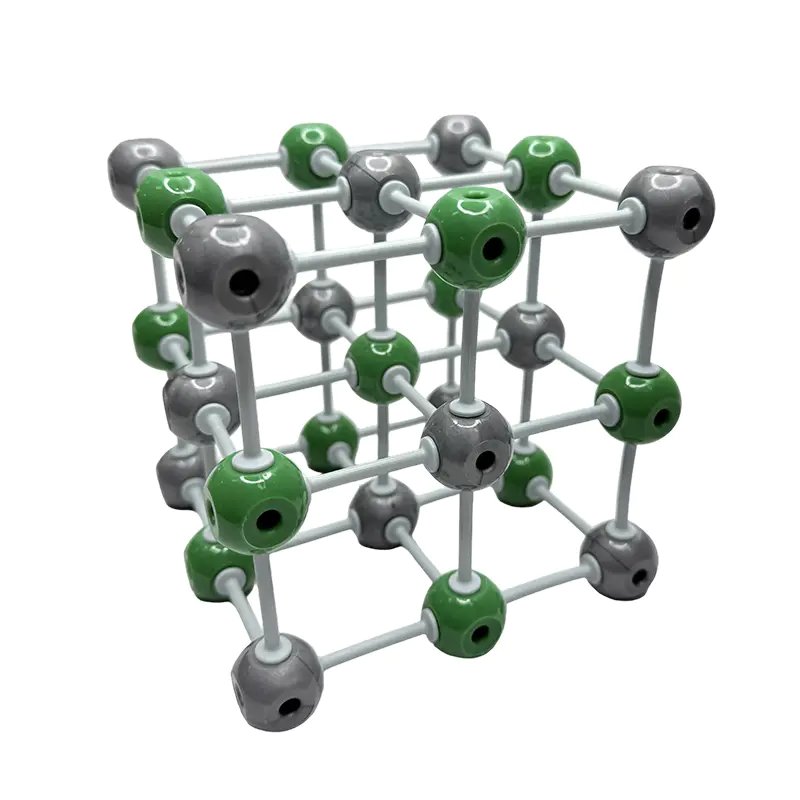
Every solid is built from tiny particles arranged in space. This chapter teaches you the language of crystallography — lattice, basis, unit cell, symmetry and the 14 Bravais lattices. Master these basics once, and the whole unit on solids becomes easy.
Solids are of two types, based on how their particles (atoms, ions or molecules) are arranged.
Crystalline solids: particles have a definite, orderly, repeating arrangement over long distances (long-range order). Examples: NaCl (common salt), diamond, quartz (SiO2), sucrose.
Amorphous solids (Greek a-morphous = without shape): particles have only a short-range order — a regular arrangement in a small region, but no long-range repetition. Examples: glass, rubber, plastics, gels.
Property
Crystalline solids
Amorphous solids
Arrangement of particles
Definite, repeating, long-range order
Irregular, only short-range order
Geometrical shape
Definite characteristic shape
Irregular shape
Melting point
Sharp and fixed
Soften gradually over a range of temperature
Cleavage
Break along definite planes, giving smooth surfaces
Break irregularly
Anisotropy
Anisotropic — physical properties (like refractive index, conductivity) differ in different directions
Isotropic — same properties in all directions
Heat of fusion
Definite value
Not definite
Examples
NaCl, diamond, quartz, metals
Glass, rubber, plastics, pitch
Note: Amorphous solids are sometimes called supercooled liquids or pseudo-solids, because their particles are arranged like in a liquid but they do not flow. Glass is the classic example — it flows extremely slowly, which is why very old window panes are thicker at the bottom.
💡 Memory trick: Remember "S-M-C-A" for crystalline solids — Sharp melting point, Maintained order, Cleavage planes, Anisotropic. Amorphous solids are the opposite of each letter.
Crystalline vs Amorphous Solids
Crystalline solids (like NaCl) have particles in a regular repeating pattern; amorphous solids (like glass) do not.
📍
Lattice, Basis and Crystal Structure
Three small words that students often confuse. Learn them as one set.
Lattice (space lattice): a regular three-dimensional arrangement of points in space. Each point represents the position of a particle (atom, ion or molecule). The lattice itself is imaginary — it is just the scaffolding.
Basis (motif): the group of one or more atoms associated with each lattice point. The basis is identical at every lattice point.
Crystal structure = lattice + basis. When the same basis is placed on every point of the lattice, we get the real crystal.
Crystal structure = Space lattice + Basis
💡 Exam one-liner: "Lattice tells where the points are; basis tells what sits on each point." Write this sentence in exams — examiners like it.
Exam tip: A very common 2-mark question: "Distinguish between lattice and crystal." Answer: lattice is the imaginary array of points; crystal is the real solid obtained by putting the basis (actual atoms) on every lattice point.
Lattice + Basis = Crystal Structure
A lattice is a regular array of points; placing the same basis (motif) of atoms on every point gives the crystal structure.
🧊
Unit Cell and Lattice Parameters
Unit cell is the smallest repeating unit of the crystal. If we repeat it in all three directions, the whole crystal is built up — just like a single brick repeated builds a wall.
Primitive unit cell: has lattice points only at its corners → 1 lattice point per unit cell.
Centred (non-primitive) unit cell: has lattice points at corners plus extra points at the body centre, face centres or base centres → more than one lattice point per cell.
Lattice parameters
A unit cell is described by six numbers:
a, b, c — the lengths of the three edges of the unit cell.
α, β, γ — the angles between the edges (α between b and c, β between a and c, γ between a and b).
Exam tip: Always write both sets. A popular question: "What are lattice parameters?" — answer with all six, a, b, c and α, β, γ, plus a small labelled sketch of a parallelepiped unit cell.
Unit Cell Parameters
A unit cell is described by three edge lengths (a, b, c) and three angles (α, β, γ). Dashed edges are hidden behind.
🔄
Symmetry Elements in Crystals
Symmetry operation is a movement of the crystal after which it looks exactly the same as before. The imaginary point, line or plane about which the operation is carried out is called a symmetry element. The main symmetry elements are:
🔁 Proper rotation axes (n-fold)
Rotation by 360°/n about an axis leaves the crystal unchanged. Only 1, 2, 3, 4 and 6-fold axes are possible in a periodic crystal. A 5-fold axis (or 7, 8…) can never exist in a crystal.
🪞 Plane of symmetry (m)
An imaginary plane that divides the crystal into two halves, each a mirror image of the other.
🎯 Centre of symmetry (i)
A point such that any line drawn through it meets the crystal at equal distances on both sides. Also called centre of inversion.
🌀 Roto-inversion axes
Combined rotation followed by inversion through a point. These are the "improper" symmetry operations.
Why no 5-fold axis? You cannot fill space by repeating a pentagon without leaving gaps — five-fold symmetry cannot give a repeating (periodic) lattice. This is a favourite viva/exam question.
Combining all possible symmetry elements gives 32 point groups (crystal classes), which fall into the 7 crystal systems.
Exam tip: If asked "Why is a 5-fold axis of symmetry not possible in crystals?" — write: a lattice must fill space by repetition without gaps; regular pentagons cannot tile a plane, so 5-fold rotation is incompatible with translational symmetry.
Symmetry Elements of a Cube
A cube has 4-fold rotation axes through face centres, mirror planes, and a centre of symmetry — total 48 symmetry operations (point group Oh).
📊
The 14 Bravais Lattices
Auguste Bravais (1848) showed that there are only 14 distinct space lattices in three dimensions, grouped into 7 crystal systems. Every crystal belongs to one of them.
💡 Memory trick: Count of Bravais lattices per system — 3-2-4-1-1-2-1. Read it as a phone number: "324-1121". Total = 14.
Careful: NaCl and diamond have an fcc arrangement, but NaCl is not "an fcc Bravais lattice" by itself — its basis contains two different ions (Na+ and Cl−). The lattice is fcc; the basis is Na+ + Cl−.
The Three Cubic Bravais Lattices
Simple cubic has atoms only at corners; bcc adds one atom at the body centre; fcc adds atoms at all face centres.
🔢
Atoms per Unit Cell & Coordination Number
An atom at a corner is shared by 8 unit cells → counts as 1/8. An atom at a face centre is shared by 2 cells → counts as 1/2. An atom at the body centre belongs fully to one cell → counts as 1.
Worked calculations
Simple cubic (sc): 8 corners × 1/8 = 1 atom per unit cell. Coordination number = 6.
Body-centred cubic (bcc): (8 × 1/8) + 1 body atom = 2 atoms per unit cell. Coordination number = 8.
Face-centred cubic (fcc): (8 × 1/8) + (6 × 1/2) = 1 + 3 = 4 atoms per unit cell. Coordination number = 12.
Density of a crystal: ρ = Z·M / (NA·a³) — where Z = atoms per unit cell, M = molar mass, NA = Avogadro number, a = edge length.
Cubic type
Atoms per unit cell (Z)
Coordination number
Packing efficiency
Relation r–a
Simple cubic
1
6
52.4%
a = 2r
bcc
2
8
68%
√3·a = 4r
fcc
4
12
74%
√2·a = 4r
Exam tip: Numerals like "Calculate the number of atoms per unit cell in fcc" are gift marks. Always show the working (8 × 1/8 + 6 × 1/2 = 4) — writing only "4" may lose the step mark.
Counting Atoms in Cubic Unit Cells
A corner atom is shared by 8 cells (counts 1/8), a face-centre atom by 2 cells (counts 1/2), and a body-centre atom belongs fully to one cell.
✎ PYQ Zone — Chapter 1
Every previous-year question from this chapter's topics, with year, paper, marks and a full exam-ready answer. Tap a question to open its detailed solution.
2024B.Sc. DSE-12 marks
Q1(e) — “What are the dimensional characteristics of a triclinic Bravais lattice?” ⭐⭐
📖 Detailed answer ▼
The triclinic crystal system is the least symmetric of all seven systems. Its unit cell is described by:
Edge lengths: a ≠ b ≠ c (all three unequal)
Interfacial angles: α ≠ β ≠ γ ≠ 90° (all three unequal and none is a right angle)
There is only one Bravais lattice in this system — the primitive (P) lattice, because centring a triclinic cell always produces an equivalent smaller primitive cell. Example: CuSO4·5H2O.
Memory trick: “Tri = three” — three unequal edges, three unequal angles, one lattice.
2023B.Sc. DSE-12 marks🔁 also 2019
Q1(a) — “Name the different types of Bravais lattices that can be obtained for a tetragonal crystal. Find the number of atoms per unit cell for a body-centred tetragonal crystal.” ⭐⭐⭐
Repeated: 2019 · B.Sc. DSE-1 · Q1(a) · 2 marks (“What is meant by a 'tetragonal class of crystal'? Find the number of atoms per unit cell for a body-centred tetragonal crystal.”)
📖 Detailed answer ▼
Tetragonal class: a = b ≠ c and α = β = γ = 90°. Two edges equal, the third different, all angles right angles.
Bravais lattices possible: two —
Primitive (simple) tetragonal, P
Body-centred tetragonal, I
(Face-centred and base-centred tetragonal cells reduce to one of these two, so they are not counted separately.)
Atoms per unit cell (Z) for body-centred tetragonal: 8 corners × ⅛ + 1 body centre × 1 = 2 atoms.
Exam line: Tetragonal → 2 lattices (P and I); Z = 2 for the body-centred cell.
2019B.Sc. DSE-13 marks
Q2(a)(i) — “Five-fold rotational axis of symmetry is impossible in case of a crystal. Justify.” ⭐⭐⭐
📖 Detailed answer ▼
This is the crystallographic restriction theorem: only 1-, 2-, 3-, 4- and 6-fold rotation axes can exist in a crystal.
Proof in simple words: a crystal must fill space by repeating its unit cell with no gaps. Take a row of lattice points with spacing a. Rotating the lattice by angle θ about a lattice point must carry lattice points onto lattice points, so the new translation produced is 2a·cosθ, which must be an integral multiple of a:
2cosθ = integer (m)
For a 5-fold axis, θ = 72°, and 2cos72° = 0.618 — not an integer. So a 5-fold rotation cannot map a lattice onto itself. Trying to tile space with pentagons always leaves gaps.
Allowed values give θ = 360°, 180°, 120°, 90°, 60° — i.e. 1-, 2-, 3-, 4- and 6-fold axes only.
2019B.Sc. DSE-12 marks
Q2(b)(ii) — “By means of lattice diagram, show the possible Bravais lattices in case of an orthorhombic system of crystals.” ⭐⭐
📖 Detailed answer ▼
Orthorhombic system: a ≠ b ≠ c, α = β = γ = 90°. It has the maximum number of Bravais lattices — four:
Primitive (P): lattice points only at the 8 corners → Z = 1
Base-centred (C): corners + 2 face centres (top and bottom faces) → Z = 2
Body-centred (I): corners + 1 body centre → Z = 2
Face-centred (F): corners + 6 face centres → Z = 4
In the exam, draw four small boxes: an empty box (P), a box with dots on top/bottom faces (C), a box with a centre dot (I), and a box with dots on all faces (F). Label a ≠ b ≠ c beside each.
2024B.Sc. DSE-12 marks
Q2(a)(i) — Justify or criticize: “Miller indices of a crystal face actually refer to a class of faces.” ⭐⭐
📖 Detailed answer ▼
The statement is correct — justify it.
Miller indices (hkl) do not describe one single face; they describe a family of parallel, equally spaced planes. Any plane parallel to a given (hkl) plane, at any distance from the origin, has the same indices — because the indices come from the ratios of reciprocal intercepts, and parallel planes cut the axes in the same ratio.
Example: in a cubic crystal all six cube faces belong to the family {100} — (100), (010), (001) and their negatives. One symbol, a whole class of equivalent faces.
2024B.Sc. DSE-13 marks
Q2(a)(ii) — “Find the intercepts made on the three axes by the first (most near to the origin) two planes among the class represented by the Miller indices (2̄10). Depict the two planes.” ⭐⭐⭐
📖 Detailed answer ▼
Step 1 — intercepts from Miller indices. Intercepts are proportional to the reciprocals of the indices:
So the planes cut the x-axis at a/2, the y-axis at −b, and are parallel to the z-axis.
Step 2 — the first two planes nearest the origin. A “class” (family) of planes (hkl) is the whole set of parallel, equally spaced lattice planes hx/a + ky/b + lz/c = m, where m = 0, ±1, ±2, … Each integer m is one plane of the family, and its perpendicular distance from the origin is |m|·dhkl. The two planes most near to the origin are therefore m = +1 and m = −1 (both at distance d2̄10 from the origin, on opposite sides of it).
Note: halving the intercepts to (a/4, −b/2, ∞) would give 2x/a − y/b = 4 — that is the fourth plane, not the second. And (a/4, −b/2, ∞) as “half intercepts” would mean m = 1/2, which is not a lattice plane at all (it passes through no lattice points).
Step 3 — depiction. Draw the crystal axes. For plane 1, mark a/2 on the +x axis and b on the −y axis, join the marks with a straight line and extend it parallel to the z-axis. For plane 2, mark a/2 on the −x axis and b on the +y axis and draw the parallel plane on the opposite side of the origin. Both planes run parallel to the z-axis and sit equidistant from the origin — this picture shows what “a class of planes” really means.
2021B.Sc. DSE-15 marks
Q10(b) — “Designate the Miller indices of all the six faces of a simple cubic unit cell with appropriate diagram.” ⭐⭐⭐
📖 Detailed answer ▼
The six faces of a cube form the family {100}. Their Miller indices are:
Front face (cuts x at a): (100); back face: (1̄00)
Right face (cuts y at b): (010); left face: (01̄0)
Top face (cuts z at c): (001); bottom face: (001̄)
How to get them: take intercepts (e.g. a, ∞, ∞), take reciprocals (1/a, 0, 0), clear fractions → (100). A bar over the index means the intercept is on the negative axis.
Diagram: draw a cube, label the three axes x, y, z from one corner, and write each index on its face. Opposite faces differ only by the bar — this shows the “class of faces” idea clearly.
2022B.Sc. DSE-12 marks
Q3(c)(ii) — “Find out the intercepts on the crystallographic axes of a plane with Miller indices (2 0 1) with unit cell dimensions a = 6·8 nm, b = 8·6 nm and c = 4·6 nm.” ⭐⭐
📖 Detailed answer ▼
Intercepts = cell edge ÷ corresponding index:
x-intercept = a/h = 6.8/2 = 3.4 nm
y-intercept = b/k = 8.6/0 = ∞ (plane parallel to the y-axis)
z-intercept = c/l = 4.6/1 = 4.6 nm
Answer: the (201) plane cuts the x-axis at 3.4 nm and the z-axis at 4.6 nm, and runs parallel to the y-axis.
2020B.Sc. DSE-15 marks
Q3 — “Calculate the percentage of void space in a fcc unit cell. Find out the Miller indices of the plane that makes intercepts ½, 2 and 3/2 multiples of unit distances on the three axes.” ⭐⭐⭐⭐
📖 Detailed answer ▼
Part 1 — void space in fcc. Packing efficiency of fcc (ccp) = 74%. Therefore
Part 2 — Miller indices. Intercepts: ½, 2, ³⁄₂. Take reciprocals: 2, ½, ⅔. Multiply by 6 to clear fractions: (12 3 4).
Method to remember: intercepts → reciprocals → smallest whole numbers. Always clear fractions last.
2020B.Sc. DSE-15 marks
Q2 — “Derive the expression of interplanar distance for an orthorhombic system. Calculate the coordination number of an atom in 3-D close packed structure.” ⭐⭐⭐
📖 Detailed answer ▼
Part 1 — interplanar distance (orthorhombic). For axes at right angles with edges a, b, c, the perpendicular distance of the (hkl) plane from the origin is:
1/d²ₕₖₗ = h²/a² + k²/b² + l²/c²
Derivation: the plane x/(a/h) + y/(b/k) + z/(c/l) = 1 has normal direction (h/a², k/b², l/c²); the perpendicular distance from the origin gives the result above. For cubic (a = b = c) it reduces to d = a/√(h²+k²+l²).
Part 2 — coordination number in 3-D close packing. In both hcp and ccp, every sphere touches 6 neighbours in its own layer, 3 in the layer below and 3 in the layer above:
C.N. = 6 + 3 + 3 = 12
2022M.Sc. MSCH-1043 marks🔁 also 2024 (M.Sc.) + 2020 (B.Sc.)
Q1(c) — “Find the symmetry elements and operations of a cube.” ⭐⭐⭐⭐
Repeated: 2024 · M.Sc. MSCH-104 · Q1(d) · 2 marks (“…and hence comment on the symmetry elements of regular octahedron.”) · 2020 · B.Sc. DSE-1 · Q1 · 5 marks (“List the axis of symmetries that are present in a cube.”)
📖 Detailed answer ▼
A cube belongs to point group Oh with 48 symmetry operations:
Proper rotations (24): E (1); 3C4 axes through opposite face centres → 9 operations; 4C3 axes through body diagonals → 8; 6C2 axes through opposite edge mid-points → 6. Total 1 + 9 + 8 + 6 = 24.
Improper (24): inversion centre i (1); 3σh + 6σd mirror planes (9); 3S4 (6) and 4S6 (8) improper axes.
Octahedron comment (2024): the regular octahedron is the dual of the cube — joining the six face-centres of a cube gives a perfect octahedron. Faces and vertices swap, but every symmetry operation survives, so the octahedron has exactly the same elements and the same Oh group (C4 axes now pass through opposite vertices, C3 through opposite face centres).
2023B.Sc. DSE-13 marks🔁 also 2020
Q3(a)(i) — “Derive the Bragg's equation of diffraction of X-ray on a crystal. State the condition for the validity of this equation.” ⭐⭐⭐⭐
Repeated: 2020 · B.Sc. DSE-1 · Q1 · 5 marks (“Derive Bragg's equation. List the axis of symmetries that are present in a cube.”)
📖 Detailed answer ▼
Derivation: consider X-rays of wavelength λ striking parallel lattice planes spaced d apart at glancing angle θ. The ray reflected from the second plane travels an extra distance 2·d·sinθ compared with the ray from the first plane. For constructive interference (bright spot), this path difference must be a whole number of wavelengths:
nλ = 2d·sinθ (n = 1, 2, 3, …)
Conditions for validity:
λ must be comparable to the interplanar spacing (λ ≈ d, i.e. X-ray region, ~1 Å).
The crystal must be reasonably perfect — planes regularly spaced over many unit cells.
Since sinθ ≤ 1, we need nλ ≤ 2d — only orders with λ ≤ 2d/n are observable.
2023B.Sc. DSE-12 marks🔁 also 2019
Q3(a)(ii) — “In X-ray diffraction, KCl shows SC pattern though it is a FCC lattice. — Comment.” ⭐⭐⭐
Repeated: 2019 · B.Sc. DSE-1 · Q3(c)(iii) · 2 marks (“In X-ray analysis, KCl shows simple cubic type though it is FCC type like NaCl. — Why?”)
📖 Detailed answer ▼
KCl truly has the rock-salt (fcc) structure like NaCl. But X-rays are scattered by electrons, and the scattering power of an ion depends on its electron count:
K⁺ has 18 electrons; Cl⁻ also has 18 electrons — they are isoelectronic.
So every lattice point scatters X-rays identically, and the two interpenetrating fcc sub-lattices become indistinguishable.
The diffraction pattern therefore looks like that of a simple cubic lattice (with a smaller effective cell). In NaCl this does not happen because Na⁺ (10 e⁻) and Cl⁻ (18 e⁻) scatter differently.
2024B.Sc. DSE-12 marks
Q3(a)(i) — “Explain why a crystal acts as a three-dimensional diffraction grating for X-rays.” ⭐⭐
📖 Detailed answer ▼
A diffraction grating needs regularly spaced scattering centres with spacing comparable to the wavelength of the radiation:
In a crystal, atoms/ions sit on a periodic 3-D lattice with interplanar spacings of the order of 1 Å.
X-rays have wavelengths of the same order (~0.1–2 Å).
Each lattice plane reflects a tiny fraction of the beam; the reflected waves interfere constructively only at the Bragg angles.
Because the periodicity extends in all three directions, the crystal works as a three-dimensional grating — this is the basis of X-ray crystallography.
2024B.Sc. DSE-12 marks
Q3(a)(ii) — “What do you mean by order of reflection? What is its significance?” ⭐⭐
📖 Detailed answer ▼
In Bragg's equation nλ = 2d·sinθ, the integer n = 1, 2, 3, … is the order of reflection.
Meaning: it counts how many whole wavelengths fit into the path difference between successive planes. n = 1 is the first-order (strongest) reflection.
Significance: higher orders appear at larger glancing angles and are progressively weaker; since sinθ ≤ 1, only orders with n ≤ 2d/λ can occur — this limits which reflections are observable for a given crystal and wavelength.
2024B.Sc. DSE-12 marks
Q3(a)(iii) — “Find the minimum interplanar distance for a crystal to produce a diffraction spectra for a given radiation.” ⭐⭐
📖 Detailed answer ▼
From Bragg's law nλ = 2d·sinθ, with sinθ ≤ 1:
d ≥ nλ/2
For the first order (n = 1), the minimum interplanar spacing that can diffract radiation of wavelength λ is
dmin = λ/2
Planes closer than λ/2 cannot produce any diffraction pattern with that radiation.
2022B.Sc. DSE-12 marks
Q1(f) — “What is the minimum measurable value of spacing between crystal planes when the wavelength of 1·67 Å is employed?” ⭐⭐
📖 Detailed answer ▼
Using dmin = λ/2 for first-order reflection:
dmin = 1.67 / 2 = 0.835 Å
So plane spacings smaller than ≈ 0.84 Å cannot be measured with 1.67 Å X-rays.
2022B.Sc. DSE-12 marks
Q1(h) — “Why are radio waves considered to be unsuitable for determining crystal structure?” ⭐⭐
📖 Detailed answer ▼
Diffraction needs λ ≈ d (interplanar spacing ~1 Å). Radio waves have wavelengths from millimetres to kilometres — millions of times larger than atomic spacings.
From Bragg's law, sinθ = nλ/2d would far exceed 1, so no diffraction is possible. Only X-rays (λ ~ 1 Å) match the atomic scale — that is why von Laue's experiment used X-rays.
2023B.Sc. DSE-13 marks
Q2(a)(i) — “The molar volume of KCl is 1·3 times that of NaCl. The glancing angle for the 1st order Bragg reflection from the (200) plane of NaCl is 5·9°. Find the glancing angle from the (200) plane of KCl.” ⭐⭐⭐
The larger KCl cell gives a smaller glancing angle, as expected.
2021B.Sc. DSE-15 marks
Q3(b) — “Determine the highest order of reflection that can be observed in Bragg's reflection from a solid employing X-ray spectroscopic technique.” ⭐⭐
📖 Detailed answer ▼
From nλ = 2d·sinθ, since the maximum value of sinθ is 1:
nmax = 2d / λ
So the highest observable order is the largest integer less than or equal to 2d/λ. Physically: the path difference can never exceed twice the interplanar spacing, so only finitely many orders exist — and in practice intensity falls off rapidly, so usually only the first few orders are seen.
2024B.Sc. DSE-12 marks🔁 3 years
Q1(f) — “Show that the interplanar distance for a cubic crystal can never be a/√7, where 'a' is the length of an edge of the cube.” ⭐⭐⭐⭐
Repeated: 2022 · B.Sc. DSE-1 · Q3(c)(iii) · 2 marks · 2019 · B.Sc. DSE-1 · Q1(b) · 2 marks
📖 Detailed answer ▼
For a cubic crystal,
dhkl = a / √(h² + k² + l²)
For d = a/√7 we would need h² + k² + l² = 7 with integers h, k, l. But 7 cannot be written as the sum of three integer squares:
Hence no (hkl) plane has spacing a/√7. (Same logic rules out a/√15, a/√23, etc. — a favourite examiner trick.)
2019B.Sc. DSE-13 marks
Q2(d)(i) — “Show that the distance of separation between the successive (hk) planes in a two dimensional square lattice is a/√(h²+k²), where 'a' is the unit distance along X and Y axes.” ⭐⭐
📖 Detailed answer ▼
The (hk) line (plane in 2-D) makes intercepts a/h on X and a/k on Y. Its equation is
x/(a/h) + y/(a/k) = 1 → hx + ky = a
The perpendicular distance of this line from the origin is |−a|/√(h²+k²) = a/√(h²+k²). Successive parallel lines of the family are equally spaced by exactly this amount. This is the 2-D version of the cubic formula d = a/√(h²+k²+l²).
2024B.Sc. DSE-14 marks
Q3(b)(ii) — “A metal forms a cubic lattice with edge length 6·18 Å. Find the radius of an atom of the metal (taking an atom to be spherical) if the density of the metal be 1·87 g cm⁻³ & the mass of one atom of it be 132·9 a.m.u.” ⭐⭐⭐⭐
📖 Detailed answer ▼
Step 1 — find Z (atoms per unit cell).
Z = ρ·NA·a³ / M
a = 6.18 Å = 6.18×10⁻⁸ cm; a³ = 2.36×10⁻²² cm³; M = 132.9 g mol⁻¹.
Z = (1.87 × 6.022×10²³ × 2.36×10⁻²²) / 132.9 ≈ 2
Z = 2 means a bcc lattice.
Step 2 — radius. In bcc, 4r = √3·a:
r = (√3 × 6.18) / 4 ≈ 2.68 Å
Method: density → Z → identify lattice type → use the right r–a relation (sc: a = 2r; bcc: √3·a = 4r; fcc: √2·a = 4r).
2023B.Sc. DSE-13 marks
Q3(b)(iii) — “Aluminium (At. wt. 27, density 2·69 g cm⁻³) crystallises with FCC lattice. What is the distance of closest approach of Al-atoms in the crystal?” ⭐⭐⭐
Step 2 — closest approach. In fcc the nearest neighbours touch along the face diagonal: distance = a/√2 = 2r.
d = 4.05 / 1.414 ≈ 2.86 Å
2022B.Sc. DSE-13 marks🔁 also 2019
Q3(d)(i) — “Ag is known to crystallise in f.c.c. form and the distance between the nearest neighbour atoms is 2·87 Å. Calculate the density of Ag [At. Wt. of Ag = 108].” ⭐⭐⭐
(The experimental value is 10.5 g cm⁻³ — the method is what earns marks.)
2021B.Sc. DSE-15 marks
Q3(a) — “Europium (Atomic weight: 152 g·mol⁻¹) crystallizes in a bcc lattice. The density of Europium (Eu) is estimated to be 5.26 g·cm⁻³. Calculate the radius of Eu atom from above information.” ⭐⭐⭐
📖 Detailed answer ▼
Step 1 — edge length (bcc → Z = 2):
a³ = (2 × 152) / (5.26 × 6.022×10²³) ≈ 9.60×10⁻²³ cm³ → a ≈ 4.58 Å
Step 2 — radius (bcc: 4r = √3·a):
r = (√3 × 4.58) / 4 ≈ 1.98 Å
2022B.Sc. DSE-13 marks
Q3(c)(i) — “Insulin forms crystals of orthorhombic type with a = 13 nm, b = 7·48 nm and c = 3·09 nm. If the density of the crystal is 1·315 × 10³ kg/m³, and there are 66 insulin molecules per unit cell, what is the molar mass of insulin?” ⭐⭐⭐